
Innovate Guernsey doesn’t intend to be a committee that just talks; they’re ready to take action.
Guernsey is brilliant at committees. Give us a good idea, and we’ll form a working group. Give us another good idea, and we’ll form a steering group to oversee the first one.
It’s a tongue-in-cheek joke locals know well, and usually tell with a smile, but it lands because there’s a bit of truth in it. We’re not short of ideas, talent or ambition. What we struggle with is turning momentum into action.
So, when we welcomed Innovate Guernsey to host the second of their lunch series, they came prepared to arm attendees with some great tips and a session to get ideas out of the room and into practice.
The first session back in October uncovered the barriers to innovation. This time, the focus was on how we can roll up our sleeves and tackle them.
Kate Marshall, Head of Guernsey Enterprise at JT, sponsoring the event, began the session by assuring the audience that while innovation is rarely a straight line of growth, what truly unlocks potential is collaboration. This laid the groundwork for Justin Bellinger, Chair of the Innovate Guernsey Board, to set the room to work.
Each board member governed a table of professionals from a diverse range of sectors and posed three hard-hitting questions. Here are the key findings that emerged:
-
What’s the biggest risk your business isn’t taking right now and probably should be?
A common topic of conversation centred around the investment and adoption of technology such as AI, data digitisation, automation and tech stacks to unlock productivity and future capability. Concerns were raised around the difficulty of justifying foundation investments that can’t be quantified immediately in ROI, and the need for upskilling developing talent in innovative ways of working.
-
What is holding your business back from being more innovative?
Responses pointed to both practical hurdles, such as overregulation, resource and scale constraints, and outdated technology, and psychological ones, including fear of failure, reputational risk, and resistance to change.
-
How do you move your business from talk to action?
Attendees provided lots of valuable suggestions, from encouraging continuous improvement approaches, nudges and culture-building for behavioural change and investing in internal education. However, what came up as the strongest theme was the importance of creating dedicated time and space for innovation. With so many business leaders consumed by their day-to-day responsibilities, it’s clear that to really make actionable change, you need time to focus on it as a start.
By bringing together this room of enthusiastic individuals from diverse sectors, with different perspectives, it sparked collaborative solutions that connected the dots in ways far greater than the sum of their parts.
Providing a forum like this that educates leaders on how to convert conversations into cumulative growth is exactly the environment and ethos Chamber encourages.
Alice Gill, Executive Director of Guernsey Chamber of Commerce, concludes, “In a place like Guernsey it’s hard to take risks – everyone sees it when you get something wrong. But if we fail fast and move on, the pace of progress could be transformative.”
It’s clear that Innovate Guernsey is leading by example. The hope is that sessions like these provide attendees with the blueprint to go back and implement in their respective fields.
They even left the audience with some punchy new tips and tricks for them to try to free up focus time on innovation:
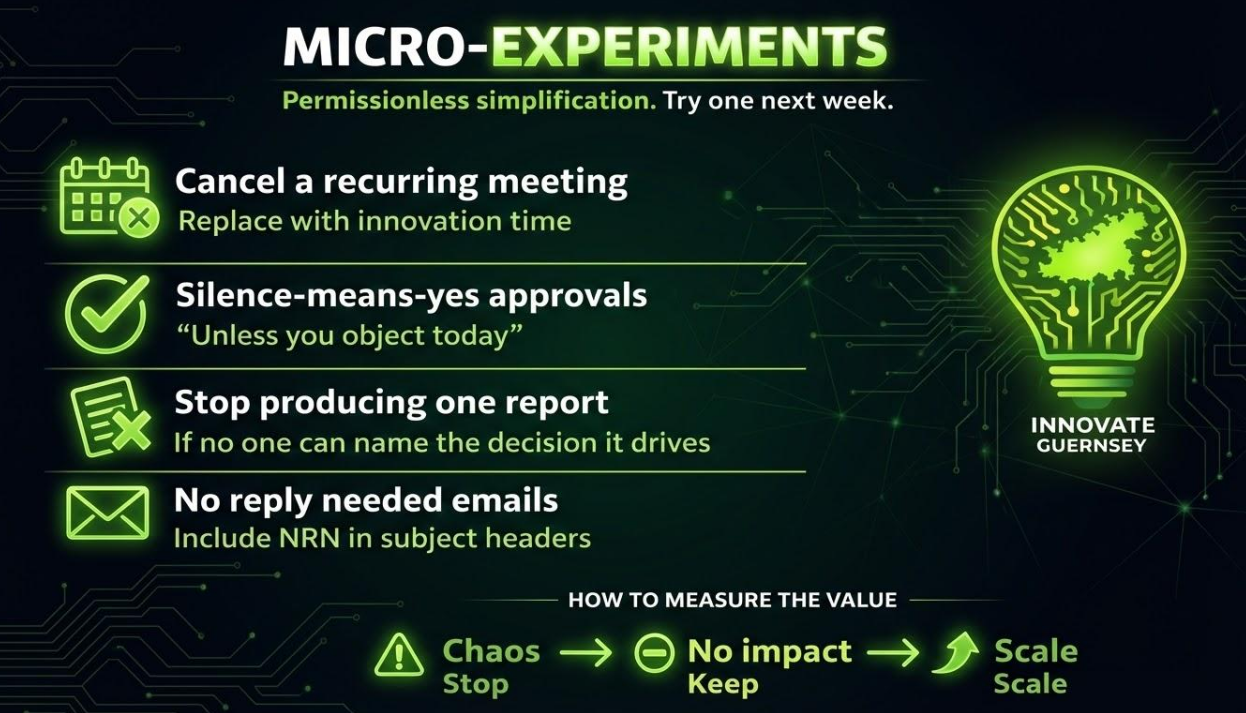
The resounding message Innovate Guernsey left us with was that innovation doesn’t happen to you; it happens from you.
So, what step are you going to take today that translates talk to action?
Many thanks to our event partner, JT
